July 2026 · 10 min read · Cervical Protocol
The Referred-Pain Problem
Cervical radiculopathy is irritation or compression of a nerve root as it exits the cervical spine — most often C5, C6 or C7. The defining feature is radiation: pain, tingling (paraesthesia) or weakness that travels along the nerve’s path, from the neck through the shoulder and arm into specific fingers, in a dermatomal pattern. Because the loudest symptom is often in the hand, the condition is frequently coded as carpal tunnel syndrome and treated at the wrong end of the arm for months. For a pain or physiotherapy clinic this is a high-value population: the diagnosis is made on physical examination, most cases resolve with conservative care, and the structures involved — the cervical spine and its soft tissue — are ones the clinic already treats.
Mechanism: Compression Plus Inflammation
Two things happen at an irritated cervical root, and only one of them is mechanical. A herniated or bulging cervical disc, or degenerative foraminal narrowing from spondylosis, physically compresses the root. Around that root, inflammatory mediators (cytokines) are released into the surrounding soft tissue, sensitising the nerve and amplifying the pain out of proportion to the mechanical load. That inflammatory, soft-tissue component — not the bony compression itself — is the target PEMF, a non-pharmacological treatment, can realistically influence. It is also why some patients have severe radicular pain with only modest imaging findings, and why treating the inflammation can change the clinical picture while the disc itself is unchanged.
How PEMF Interacts with the Irritated Root
PEMF delivers short, low-intensity, non-thermal electromagnetic pulses. The mechanisms described in the literature include effects on cell membrane potential, regulation of intracellular calcium flux, improved local microcirculation and a reduction of inflammatory mediators, with a reported decrease in local oedema around the treated tissue. In cervical radiculopathy the practical intent is to reduce the peri-radicular inflammation and oedema that sensitise the root — not to decompress it. This distinction has to be stated plainly to referring physicians: PEMF does not move a disc or open a foramen. It is a contact-free treatment for the pain and inflammation component, delivered while active rehabilitation addresses the mechanical load — and it can be applied to a neck too irritable to tolerate manual therapy in the acute phase.
The Evidence — Stated Honestly
The most directly relevant evidence is the 2026 systematic review and meta-analysis in Neurology International (PMC12943413): neuropathic pain of mechanical / radicular origin responded to PEMF with a large effect (SMD −2.35), versus a negligible effect in diffuse peripheral neuropathy (SMD −0.38). The authors conclude that PEMF functions as a targeted intervention for focal compressive neural conditions — the category cervical radiculopathy belongs to. Supporting evidence for the degenerative driver comes from Trock et al. 1994 (PubMed 7837158), whose cervical-spine RCT (n=81, 18 sessions) showed significant improvement in pain and function versus placebo, sustained at one month. The 2025 multi-center RCT (PMC11914662, n=91, five orthopedic clinics) reported 36% pain reduction versus 10% with standard care for joint and soft-tissue pain.
What the evidence does not show: there is no large dedicated RCT of PEMF in cervical radiculopathy alone. The strongest signal is the radicular subgroup of a broader neuropathic-pain meta-analysis, not a stand-alone trial. Present it as a treatment for the inflammatory component, never as a substitute for neurological work-up — and refer urgently for progressive motor weakness, gait disturbance or any sign of myelopathy.
Clinical Protocol
- Diagnosis and red-flag screening: neurological history, dermatomal mapping, strength and reflex testing; Spurling’s test to reproduce radicular pain. Myelopathy, progressive motor deficit or bowel/bladder signs are excluded and referred immediately.
- Postural load reduction: workstation and screen-height correction, phone and sleeping posture, scheduled movement breaks — the same forward-head load that drives the presentation.
- PEMF sessions: 20–30 minutes, coils positioned over the relevant cervical segment covering the exit of the irritated root. Non-thermal, low-intensity; parameters are selected by the system according to the chosen indication.
- Active rehabilitation: deep cervical flexor and scapular strengthening, nerve gliding / neural mobilisation as tolerated, and graded restoration of range.
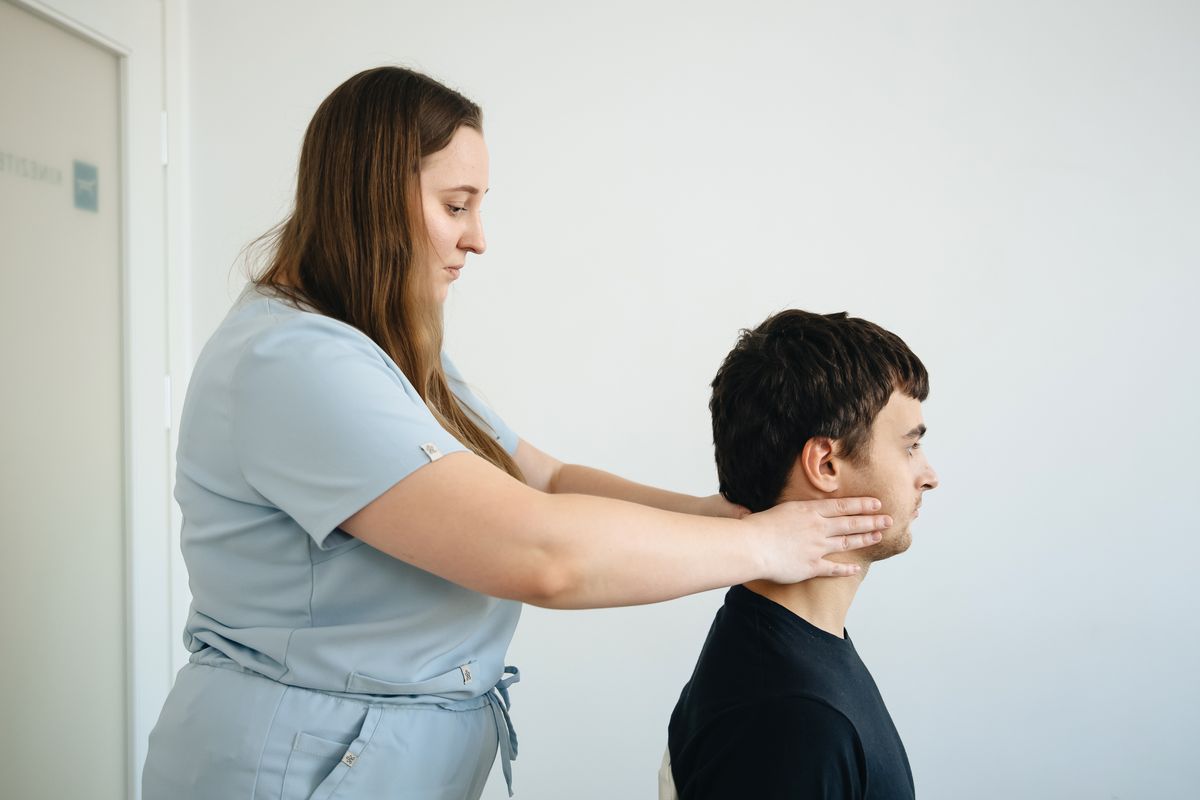
- Manual therapy between sessions: gentle cervical mobilisation and soft-tissue work according to patient status and clinician judgment.
- Reassessment every 2–4 weeks: pain intensity (NRS), the distance the pain radiates down the arm, and functional gains. Increasing weakness or spreading numbness means the diagnosis is revisited and re-referred, not that the dose is raised.
Minimum three sessions before judging response. The meaningful endpoints are how far the pain still radiates and grip/arm function — the numbers a referring orthopedic surgeon or neurologist will actually ask for.
Differential Diagnosis: Cervical Radiculopathy vs Carpal Tunnel
| Feature | Cervical radiculopathy | Carpal tunnel syndrome | Thoracic outlet syndrome |
|---|---|---|---|
| Where it starts | Neck / shoulder, radiating down the arm | Wrist and hand only | Neck / shoulder into the arm |
| Numbness distribution | Dermatomal (specific fingers by root level) | Thumb, index, middle finger (median) | Often inner arm and last two fingers (ulnar) |
| Provocation | Neck movement; Spurling’s test | Night, sustained gripping; Tinel / Phalen at wrist | Overhead arm positions, carrying loads |
| Neck pain | Usually present | Absent | May be present |
| Primary treatment target | Cervical spine and nerve root | Median nerve at the wrist | Thoracic outlet / posture |
The two can coexist (“double crush”), so the physical examination — not the patient’s existing label — decides the treatment plan.
Positioning for Philippines Clinics
Two structural features of the Philippine market make this protocol commercially relevant. First, the BPO and offshore workforce — roughly 1.3 million people working long, often night shifts at screens in fixed forward-head postures — is the country’s single most reliable generator of cervical mechanical load, and employers already carry wellness budgets. Second, upper-limb pain and numbness are overwhelmingly self-managed with over-the-counter analgesics or treated as a hand problem, so patients arrive late, after months of the wrong treatment — which is exactly the population a correctly-diagnosed cervical protocol converts.
- BPO and night-shift workers: forward-head posture plus circadian disruption; corporate wellness channel
- Motorcycle and road-traffic injuries: cervical trauma is a common radiculopathy trigger in a motorcycle-dense country
- Misdiagnosed “carpal tunnel” patients: the highest-yield group, because the cervical source was never examined
- Manual and construction workers: repetitive load and overhead work with limited access to specialist spine care
Clinic Economics
- Hands-Free delivery: the coils are positioned and the system runs independently — no therapist in the room during treatment, so a second patient can be treated in parallel.
- Purchase or operational leasing: a monthly operating payment avoids a large up-front capital outlay.
- Break-even: monthly cost divided by average revenue per session gives the number of sessions required to cover it; the network average is approximately six months.
- Broad indication basket: the same system covers cervical and radicular pain, tendinopathy, back pain, osteoarthritis, bone stress injury and sports injuries — no additional treatment room or staff line required.
Regulatory Status
- FDA 510(k): the technology’s clearance scope is pain and tissue oedema; dedicated bone-growth stimulators are additionally cleared for non-union and spinal fusion.
- CE marking: conformity with European medical device requirements.
- Israeli Ministry of Health (AMAR) registration.
- IEC 60601: international safety standard for electrical medical equipment.
- ICNIRP guidelines: safe electromagnetic exposure levels.
Contraindications
- Pacemaker or implantable cardioverter-defibrillator: absolute contraindication
- Pregnancy: absolute contraindication
- Active malignancy at the treatment site: absolute contraindication
- Metal implants near the treatment field: relative — location dependent
- Epilepsy: relative — neurologist clearance required
- Progressive arm weakness, gait disturbance, loss of dexterity or bladder/bowel changes: possible myelopathy — urgent neurological evaluation first; PEMF is never a first response to an undiagnosed progressive deficit
FAQ
How do we tell cervical radiculopathy from carpal tunnel in the clinic?
Follow the symptom and test what changes it. If the pain begins in the neck or shoulder and radiates down the arm, follows a dermatomal finger pattern, and is reproduced by neck movement or Spurling’s test, the source is cervical. If numbness is confined to the thumb, index and middle finger, worsens at night and is reproduced by Tinel or Phalen at the wrist with no neck pain, it is carpal tunnel. They frequently coexist, so the examination decides — not the referral label.
Can PEMF replace neck surgery?
No. PEMF is a conservative treatment for the pain and inflammation around the root; it does not relieve mechanical compression. Most cases settle with conservative care, and surgery is considered only for progressive neurological deficit or failed prolonged treatment — a medical decision made by the treating physician.
How long before patients feel relief?
A typical course runs 4–6 weeks at 3–5 sessions per week. Some patients report reduced pain within the first weeks, but the pace is individual and depends on the cause, severity and on pairing PEMF with rehabilitation and postural correction.
Is the treatment safe and comfortable for an irritable neck?
Yes. Low-intensity PEMF is non-invasive, involves no direct contact, pressure or tissue heating, and has no known systemic side effects. It is contraindicated in pregnancy and in patients with a pacemaker or active implant, so screening precedes treatment. A typical 20–30 minute session suits acute presentations that cannot yet tolerate manual therapy.
Interested in adding a cervical radiculopathy PEMF protocol to your clinic? Request the full investor and clinical operations brief.
Request Investment Brief →