July 2026 · 10 min read · Cervical Protocol
The Misdiagnosis Problem
Cervicogenic headache is a secondary headache: the pain is generated in the joints, discs, ligaments and suboccipital muscles of the upper cervical spine (C1–C3) and referred forward into the head. It is unilateral and stays on the same side across attacks, it starts at the occiput and climbs to the temple or behind the eye, and it is provoked by neck position and movement rather than by light, noise or food triggers. Because the pain is felt in the head, it is routinely coded as migraine or tension-type headache — and treated pharmacologically for years with partial relief at best. For a pain or physiotherapy clinic, this is a high-value population: the diagnosis is made on physical examination, not imaging, and the treatment target is a structure the clinic already treats.
Mechanism: Trigeminocervical Convergence
Sensory afferents from the upper cervical segments converge, in the trigeminocervical nucleus, with afferents from the trigeminal nerve that innervates the face and head. A nociceptive signal originating in a C2–C3 facet joint is therefore interpreted centrally as pain in the temple, forehead or retro-orbital region. This single anatomical fact explains the entire clinical picture: why the pain is felt in the head, why it is strictly unilateral, and why palpation or rotation of the neck changes its intensity. It also explains why treatment directed at the head — analgesics, triptans — produces incomplete results while treatment directed at the cervical source does not.
What Actually Works for Cervicogenic Headache?
Because the pain is generated in the neck and only felt in the head, the treatments that work are the ones aimed at the upper cervical spine. At PainFree clinics, PainFree's electromagnetic pulses lead, and the hands-on and active work continues together with them:
- PEMF — for pain and tissue oedema at the cervical source. Thirty-minute sessions, one to two per week, with no contact on an irritable neck. It can start from the first visit, including for a neck that does not yet tolerate manual work, and it is what lets the patient do the physiotherapy and exercises and keep at them.
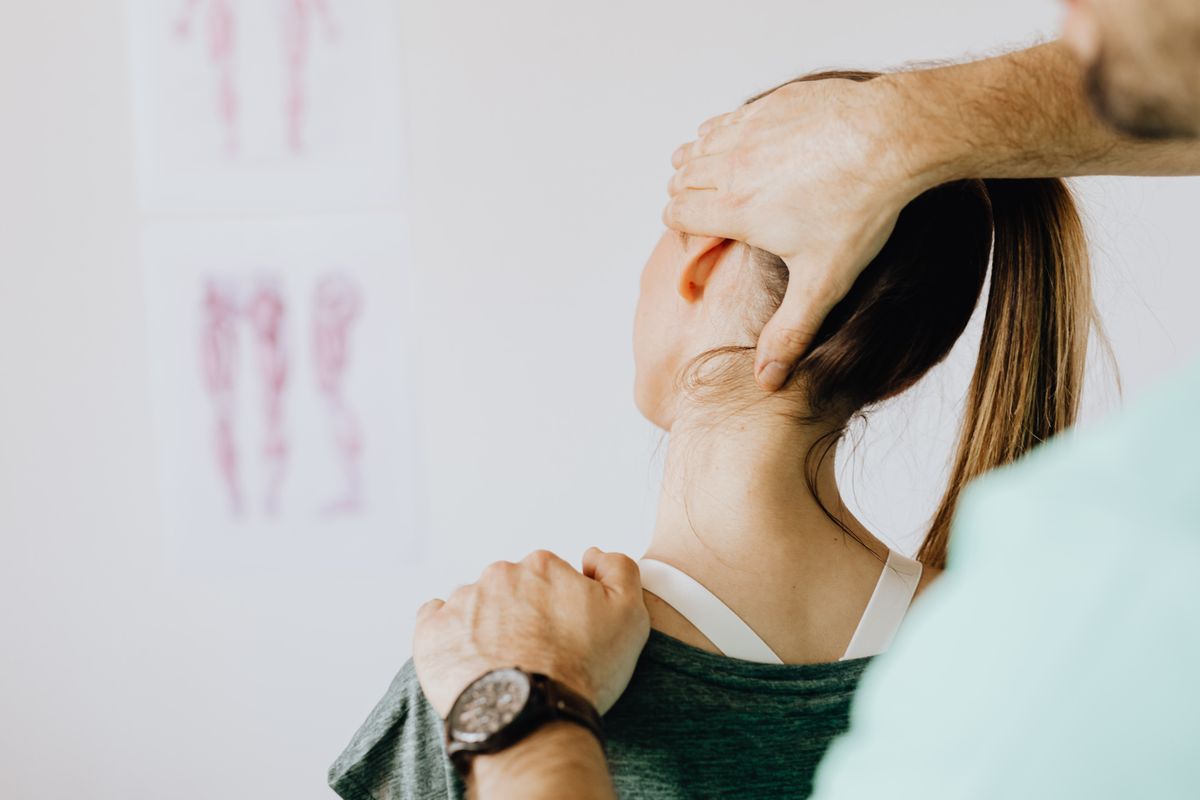
- Manual therapy and cervical physiotherapy — mobilisation of C1–C3, release of the suboccipital musculature and restoration of range of motion. Of the hands-on options, this has the strongest evidence.
- Deep cervical flexor strengthening — the active work that stops the pain returning. Slow, unglamorous, and what holds over time.
- Postural load reduction — screen height, pillow, phone habits and movement breaks. Without this, every other treatment erodes against the same driver that produced the pain.
- Analgesics — they blunt the sensation and do not touch the source. Sustained use carries its own risk of medication-overuse headache.
The combination is the point: PEMF leads on pain and tissue oedema at the source, and the manual therapy, strengthening and postural work continue together with it.
How PEMF Interacts with the Cervical Source
PEMF delivers short, low-intensity, non-thermal electromagnetic pulses. The mechanisms described in the literature include effects on cell membrane potential, regulation of intracellular calcium flux, increased ATP production, improved local microcirculation and reduction of inflammatory mediators. In the cervical application, the practical effect reported is a reduction in local oedema and tenderness around the facet joints and suboccipital musculature — precisely the structures generating the referred pain. One operational advantage matters in this population specifically: the treatment requires no contact, pressure or stretch of an irritable neck, so it can be delivered to patients who do not yet tolerate manual therapy in the acute phase.
The Evidence — Stated Honestly
The most relevant evidence for joint and soft-tissue referred pain is the 2025 prospective multi-center randomized clinical trial (PMC11914662, n=91, five orthopedic clinics): 36% pain reduction versus 10% with standard care (p<0.0001), and a 55% reduction in medication use versus 12%. In the cervical spine itself, Trock et al. 1994 (PubMed 7837158) ran two parallel randomized controlled trials — knee (n=86) and cervical spine (n=81), 18 half-hour sessions — and reported statistically significant improvement in pain, pain on motion and global assessment versus placebo, sustained at one-month follow-up. A second randomised, double-blind, sham-controlled trial (Rheumatology International 2006, PubMed 15986086, n=34, cervical osteoarthritis) found that after 3 weeks of PEMF, pain, cervical range of motion and the Neck Pain and Disability Scale improved and paravertebral muscle spasm decreased, with no change in the sham group. Where a radicular component coexists, the 2026 systematic review and meta-analysis in Neurology International (PMC12943413) pooled 13 sham-controlled trials and found a large, clinically significant pain reduction with PEMF in spinal and nerve-root compression pain, including cervical disc herniation and cervical radiculopathy — markedly more than in diffuse peripheral neuropathy.
What the evidence does not show: there is no large dedicated RCT of PEMF in cervicogenic headache specifically. The studies above address joint pain, soft-tissue pain and the cervical spine. The transfer to cervicogenic headache is at the level of the source structure and the mechanism — not direct clinical proof. Clinics should present it that way to referring physicians; overstating it is the fastest way to lose an orthopedic or neurology referral channel.
Clinical Protocol
- Diagnosis and exclusion: cervical physical examination, range-of-motion testing and palpation of C1–C3. Red flags excluded and medical referral made where a dangerous primary or secondary headache is suspected.
- Postural load reduction: workstation and screen-height correction, phone habits, pillow and sleeping position, scheduled movement breaks during the working day.
- PEMF sessions: 30 minutes, 1–2 times per week, coils positioned over the upper cervical and suboccipital region. Parameters — waveform, frequency and cycle duration — are selected by the system according to the chosen indication.
- Active rehabilitation: deep cervical flexor strengthening and motor control, scapular work, suboccipital mobility and restoration of range.
- Manual therapy between sessions: cervical mobilisation and soft-tissue work according to patient status and clinician judgment.
- Reassessment every 2–4 weeks: attack frequency, pain intensity and cervical range. No improvement means the diagnosis is revisited, not that the dose is increased.
Minimum three sessions before judging response. The meaningful endpoint is headache days per month, not the intensity of a single attack — and that is also the number a referring physician will ask for.
Differential Diagnosis: Cervicogenic Headache vs Migraine
| Feature | Cervicogenic headache | Migraine | Tension-type headache |
|---|---|---|---|
| Side | Unilateral, same side every attack | Often unilateral, can alternate sides | Bilateral, band-like |
| Onset location | Occiput, radiating forward | Frontal / temporal / retro-orbital | Diffuse |
| Provocation | Neck movement, sustained posture, palpation of C1–C3 | Light, noise, sleep, hormonal and dietary triggers | Stress, sustained posture |
| Associated features | Restricted cervical range, suboccipital tenderness | Nausea, photophobia, phonophobia, aura | Usually none |
| Duration | Continuous, fluctuating over days | Hours to ~72 hours per attack | Variable |
| Primary treatment target | Cervical spine | Central / pharmacological prophylaxis | Stress and posture |
Positioning for Philippines Clinics
Two structural features of the Philippine market make this protocol commercially relevant. First, the BPO and offshore workforce — roughly 1.3 million people working long shifts at screens, often at night, in fixed forward-head postures. This is the single most reliable generator of upper-cervical mechanical load in the country, and employers already carry wellness budgets. Second, headache in the Philippines is overwhelmingly self-managed with over-the-counter analgesics; chronic analgesic use is itself a recognised cause of medication-overuse headache, which gives a clinic a clear, honest clinical argument for a non-pharmacological treatment.
- BPO and night-shift workers: forward-head posture plus circadian disruption; corporate wellness channel
- Office and hybrid workers: the standard screen-load presentation, usually already seeking physiotherapy
- Post-whiplash patients: road-traffic and motorcycle injuries; cervicogenic headache is a common late sequela
- Long-standing “migraine” patients with partial drug response: the highest-yield group, because the cervical component was never assessed
Clinic Economics
- Hands-Free delivery: the coils are positioned and the system runs independently — no therapist in the room during treatment, so a second patient can be treated in parallel.
- Purchase or operational leasing: a monthly operating payment avoids a large up-front capital outlay.
- Break-even: monthly cost divided by average revenue per session gives the number of sessions required to cover it; the network average is approximately six months.
- Broad indication basket: the same system covers cervical pain, tendinopathy, back pain, osteoarthritis, bone stress injury and sports injuries — no additional treatment room or staff line required.
Regulatory Status
- FDA: the devices we supply hold no FDA 510(k) or PMA. Other PEMF devices hold 510(k) clearances for pain and oedema; clearance is granted per model, not to the technology.
- CE marking: our Magnetobox unit carries CE marking.
- Israeli Ministry of Health (AMAR) registration 27370034: a registry listing, not an approval of efficacy.
- IEC 60601: international safety standard for electrical medical equipment.
- ICNIRP guidelines: safe electromagnetic exposure levels.
Contraindications
- Pacemaker or implantable cardioverter-defibrillator: absolute contraindication
- Pregnancy: absolute contraindication
- Active malignancy at the treatment site: absolute contraindication
- Metal implants near the treatment field: relative — location dependent
- Epilepsy: relative — neurologist clearance required
- Hyperthyroidism: relative — physician judgment
- New, sudden, or thunderclap headache; fever with neck stiffness; visual or speech disturbance; limb weakness; headache after head or neck trauma: medical evaluation first — PEMF is never a first response to an undiagnosed headache
FAQ
How do we tell cervicogenic headache from migraine in the clinic?
Test what changes the pain. If neck rotation, sustained screen posture or palpation of the upper cervical segments reproduces or intensifies it, there is a cervical component. If the pain is throbbing, accompanied by nausea, photophobia and aura, and is unaffected by neck examination, it is migraine. The two coexist frequently, so the physical examination — not the patient’s existing label — decides.
Does PEMF replace physiotherapy for these patients?
No — the pulses don't come instead of physiotherapy; they are what lets you do it and keep at it. In the cervical spine, two controlled trials (Trock 1994, n=81; Rheumatology International 2006, n=34) measured less neck pain with PEMF than with placebo or sham, and the second also measured better range of motion. Deep cervical flexor strengthening, motor control and postural correction continue together with the pulses.
How many sessions before we know if it is working?
Most patients report a change in pain within a few sessions, but response varies. Evaluate after at least three sessions, and track headache days per month rather than single-attack intensity — that is the outcome that reflects real change and the one a referring physician will act on.
Is the treatment uncomfortable for an irritable neck?
No. It is non-invasive, involves no direct contact, pressure or tissue heating, and most patients describe it as comfortable. A typical session is 30 minutes with no recovery period, which is why it suits acute presentations that do not yet tolerate manual therapy.
Interested in adding a cervical PEMF protocol to your clinic? Request the full investor and clinical operations brief.
Request Investment Brief →