August 2026 · 12 min read · Integrative Protocol
The Short Answer
Cupping therapy has a real but modest short-term effect on chronic neck and back pain — and one uncomfortable finding belongs up front: against sham cupping, the difference largely disappears. A 2026 meta-analysis of 9 RCTs (N=401) found cupping reduced chronic neck pain (Cohen's d = 1.17, 95% CI 0.26–2.09, p=0.002) with a strikingly consistent functional improvement (d = 0.77, 95% CI 0.63–0.91, p<0.001, I²=0%). But an 18-trial meta-analysis (N=1,172) found a large effect versus no treatment (SMD −1.03) and no significant difference versus sham cupping (SMD −0.27, 95% CI −0.58 to 0.05). PEMF, tested separately, reduced chronic low back pain in a 14-trial meta-analysis (N=618, SMD −1.01, p<0.001). The two have never been tested together in a single randomised controlled trial — a PubMed cross of cupping and PEMF returns zero records.
What Cupping Actually Does
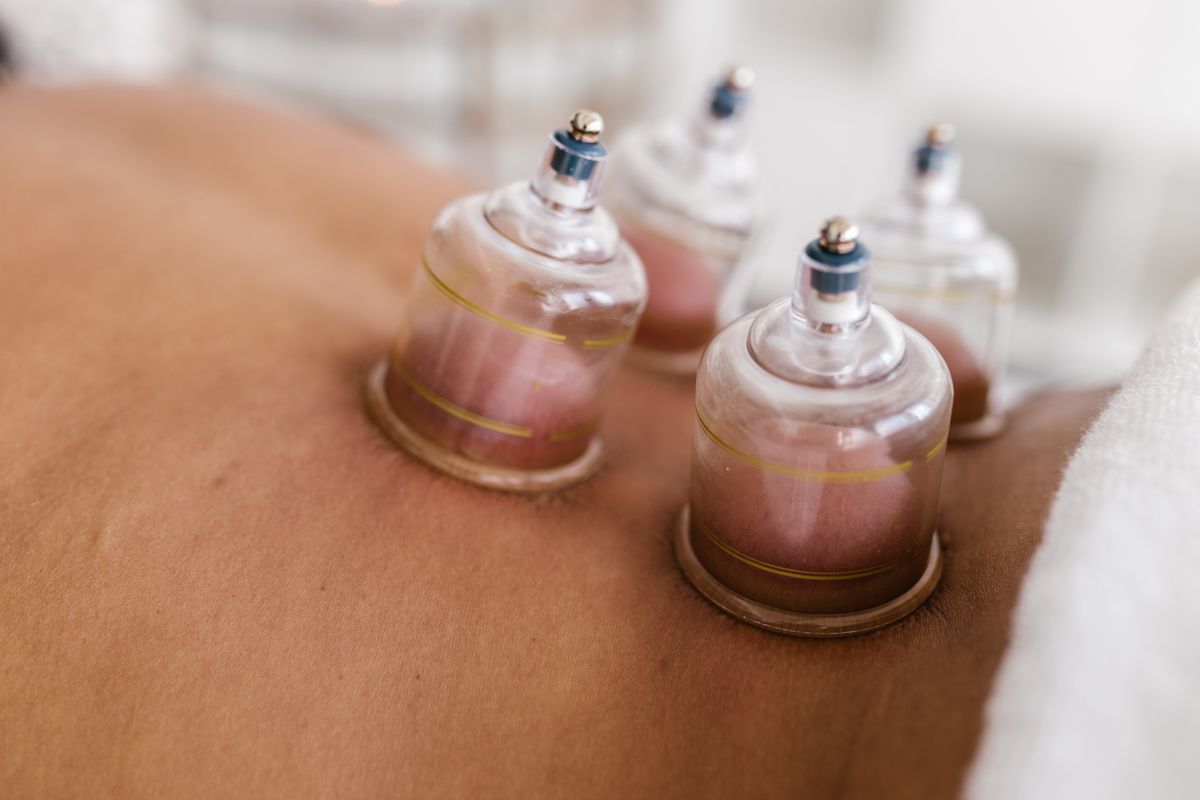
Cups placed on the skin create a local vacuum that lifts the skin and superficial soft tissue. There are two families: dry cupping (vacuum only) and wet cupping, or hijama (superficial skin scratches, with blood drawn into the cup). The proposed mechanism is mechanical decompression of the tissue, a local change in subcutaneous blood flow, and modulation of local nociceptors.
The circular marks are not "toxins leaving the body." They are ecchymosis — local capillary bleeding under the skin, which typically resorbs within days.
A 2023 evidence review of 22 studies graded with PEDro (PubMed 35848010) is candid about where the ceiling sits: evidence is moderate for improving soft-tissue flexibility, low to moderate for low back and cervical pain, and very low to low for other musculoskeletal conditions — with a very low incidence of adverse events.
What the Research Shows
The strongest positive signal is in chronic neck pain. A 2026 meta-analysis in the Journal of Back and Musculoskeletal Rehabilitation (9 RCTs, N=401, PubMed 42105092) found significant pain reduction and, more notably, a functional improvement on the NDI with zero heterogeneity between trials — complete agreement across studies on the function outcome. No serious adverse events were reported.
Across chronic musculoskeletal pain more broadly, a 2025 BMJ Open meta-analysis (PubMed 40441767) found a significant reduction in pain intensity (SMD −1.17, 95% CI −1.93 to −0.42, p=0.002) at moderate GRADE quality — but no improvement in functional disability (SMD −0.24, p=0.51) and none in mental health (SMD 0.08, p=0.46), with very high heterogeneity (I²=94%).
In low back pain, an 11-trial meta-analysis (N=921, PubMed 38184285) found pain improvement at the 2–8 week endpoint (d = 1.09, p=0.004) and improved disability at 1–6 month follow-up (d = 0.67, p=0.03). Two qualifications belong in the same breath: the pain effect was not sustained at one month (d = 0.11, p=0.85) or at 3–6 months (d = 0.39, p=0.11), and by cupping type, wet cupping showed a significant effect (d = 1.5, p=0.008) while dry cupping did not (d = 1.06, p=0.14).
What the Research Did NOT Find — Stated Plainly
The real test of any passive modality is the comparison against a sham, and this is where the picture changes. A Journal of Pain meta-analysis of 18 RCTs (N=1,172, PubMed 31982686) found a large effect for cupping versus no treatment (SMD −1.03, 95% CI −1.41 to −0.65) but no significant difference versus sham cupping (SMD −0.27, 95% CI −0.58 to 0.05). A substantial share of the observed benefit may come from the therapeutic encounter and expectation rather than from the vacuum itself.
And one trial closes the question in a specific indication. A placebo-controlled RCT published in the Brazilian Journal of Physical Therapy in 2026 (N=62 women with knee osteoarthritis, 12 sessions of dry cupping, 15 minutes, twice weekly for 6 weeks; PubMed 41043303) found improvement within each group and no between-group difference at all in pain, function, quality of life or global perceived effect — at any of four measurement points. Dry cupping is not a treatment for knee cartilage degeneration, and a patient who asks deserves that answer.
The central gap, which we state first: a PubMed search crossing cupping therapy with pulsed electromagnetic fields returns zero studies. Not one controlled trial has tested this pair. What has been tested is each component separately, plus PEMF combined with a different external Chinese modality. That is a reasonable mechanistic basis — it is not evidence that the combination beats either component alone.
Where PEMF Fits
Here the evidence base is firmer, and it is also not uniform. A meta-analysis in Clinical Rehabilitation (14 RCTs, N=618, PubMed 35077249) found PEMF reduced back pain more than placebo (SMD −1.01, 95% CI −1.42 to −0.6, p<0.001, I²=31%), with a significant effect in chronic low back pain (SMD −0.6, p<0.001) — but no significance in acute low back pain (p=0.09) and no significant improvement in physical function (p=0.09). The 2025 multi-centre trial in joint and soft tissue pain (N=91 across 5 orthopaedic clinics, PMC11914662) showed a 36% pain reduction versus 10% with standard care (p<0.0001) and a 55% drop in medication use.
The closest evidence to the combination question comes from a double-blind, placebo-controlled trial in 120 patients with lumbar myofascial pain syndrome (PubMed 36405282), where PEMF was combined with an external heating Chinese paste: the combination group had significantly lower VAS, PPI and PRI scores than control. That is PEMF with a different Chinese modality — not with cupping, and it should be presented that way.
The Clinical Logic of Combining Them
The rationale is a division of labour by depth and by type of stimulus. It is mechanistic, not trial-derived.
Cupping works mechanically, from the outside in: the vacuum stretches skin, fascia and superficial muscle layers, recruiting a local response in a limited area. Pulsed electromagnetic fields work volumetrically, from the inside: a changing magnetic field induces a small current in the tissue, affects cell membrane potential, and modulates oedema, local inflammation and microcirculation across the entire tissue volume in the field — through clothing, without contact and without heating. In one line: the cup works on the layer, the field works on the volume.
One practical advantage follows directly from the mechanism: cupping leaves ecchymosis and local skin sensitivity, and PEMF requires no contact at all — so it can be applied immediately after the cups are removed, over the same area, without adding mechanical stimulus to already-irritated skin.
The Combined Session, Step by Step
- Diagnosis and screening first. Confirm the diagnosis against the medical record and rule out contraindications for each modality separately.
- Cupping (about 10–15 minutes). Applied to the myofascial region, according to the practitioner's training and sterility protocol — especially for wet cupping.
- PEMF (about 30 minutes). The patient lies fully clothed, the coil is placed over the region; no sensation, no heating, no contact.
- Active exercise immediately afterwards, in the same visit. The reduced-pain window after the PEMF session is what lets you do it and keep at it.
Typical clinic frequency: 1–2 sessions per week; up to three in difficult cases at the start, with a rest day between. Series length is at the practitioner's discretion, and no fewer than three sessions before assessing response.
Contraindications — When Not to Treat
For PEMF: pacemaker, defibrillator or other active electronic implant, pregnancy, active epilepsy, and active malignancy.
For cupping: bleeding disorders or anticoagulant therapy, local infection or open wound, very fragile skin (for example under prolonged corticosteroid therapy), and areas with prominent varicosities or bony prominences. Wet cupping additionally requires full sterile technique, because it breaches the skin.
Red flags requiring urgent medical assessment rather than a treatment booking: change in bowel or bladder control or saddle anaesthesia; genuine motor weakness in a limb; severe night pain that wakes the patient and does not change with position; or pain accompanied by fever, night sweats or unexplained weight loss. Neither cupping, nor PEMF, nor a home device should be used to delay that assessment.
Comparison: Cupping, Dry Needling, PEMF and Shockwave
| Parameter | PEMF | Cupping | Dry Needling / IMS | Shockwave |
|---|---|---|---|---|
| Mechanism | Pulsed magnetic field through the tissue volume | Vacuum stretching skin, fascia, superficial muscle | Mechanical release of a trigger point | Focused acoustic pressure waves |
| Invasiveness | Non-invasive, works through clothing | Non-invasive (dry); skin incision (wet) | Invasive — needle into muscle | Non-invasive |
| Marks on skin | None at all | Circular ecchymosis for several days | Usually none; occasional small bruise | Occasional transient redness |
| Area of effect | Volumetric — the whole region in the field | Superficial, limited to cup diameter | Highly focal | Small to medium focus |
| Evidence depth | 14 RCTs, N=618 (back); multi-centre trial N=91 | 9 RCTs, N=401 (neck); 18 RCTs, N=1,172 — no advantage vs sham | 20 RCTs, N=1,234 (knee) | Large; outperformed PEMF in a direct knee comparison |
| Practitioner time | Hands-free — the system runs on its own | Presence needed to apply and remove | Active presence throughout | Active presence throughout |
Clinic System or Home Device?
Three categories should not be confused: a clinical PEMF system operated in a clinic after diagnosis; a medical-grade home PEMF device, which PainFree rents or sells to patients for home rehabilitation; and consumer wellness products (mats and mattresses), which are not medical equipment and carry no defined indication.
The clinical system has the highest field intensity, the full coil range and an indication-specific protocol library. The medical-grade home device is more powerful than the common consumer home devices and less powerful than the clinical system — its advantage is frequency: daily, even twice daily use, versus 1–2 sessions a week in clinic. For a symptom that follows a daily cycle, cumulative dose is the real difference between the two routes. Cupping itself is performed in clinic only; the home device is used between sessions.
The technological contrast with consumer gadgets is physics rather than marketing: infrared and laser light are absorbed in the superficial layers of skin, while a magnetic field passes through tissue and bone without significant absorption. PEMF devices with FDA 510(k) clearance for pain and oedema exist on the market, as do devices carrying CE marking. Regulatory clearance always applies to a specific device model and has an expiry date — ask to see the current certificate for the model offered to you.
Interested in adding PEMF to your clinic?
Request the full investment brief — machine specs, financials, and site selection for the Philippines market.
Request Investment Brief →How the PainFree System Grows Clinic Revenue
- Better treatment outcomes — integrative medicine at its best. Combining modalities that work in different ways generally produces a better result than a single treatment type alone. The supporting evidence is positive but moderate: 41 RCTs, N=6,858, pain SMD 0.21 and disability SMD 0.23 at moderate quality (PubMed 25694111).
- A materially wider range of indications. A large share of indications cannot be treated in the clinic without PEMF equipment — fractures and delayed union, cartilage degeneration, chronic inflammatory conditions and more.
- Lower patient acquisition cost. Marketing works better because patients prefer a technology tested in controlled trials, leading a plan that combines it with hands-on care, over a single modality.
- Hands-free treatment. The session requires no continuous supervision, so a second patient can be treated in parallel on each device. That revenue is additional to the manual-therapy fee and does not compete with it, so it raises the value of the clinic hour.
- A full professional envelope. Complete clinical training, a structured protocol book, and ongoing technical and clinical support, drawn from many years in integrative medicine clinics.
- Meaningful differentiation. A clinic offering an integrated envelope stands apart from a clinic offering a single modality — to patients, to referring physicians, and to search engines.
Five Points to Remember
- Cupping reduces neck and back pain in the short term — but shows no significant advantage over sham cupping.
- In knee osteoarthritis, a 2026 placebo-controlled RCT found no benefit at all.
- PEMF showed significant pain reduction in chronic low back pain, but no significant functional improvement.
- The cupping + PEMF pair has never been tested in a controlled trial — it rests on mechanism and clinical reasoning alone.
- Both are pain-reducing components within a programme centred on active exercise, and neither replaces medical diagnosis.
Sources
- Effect of cupping therapy on chronic neck pain: A systematic review and meta-analysis of randomized controlled trials. Journal of Back and Musculoskeletal Rehabilitation 2026 — PubMed 42105092
- Effects of cupping therapy on chronic musculoskeletal pain and collateral problems: a systematic review and meta-analysis. BMJ Open 2025 — PubMed 40441767
- The effectiveness of cupping therapy on low back pain: A systematic review and meta-analysis of randomized control trials. Complementary Therapies in Medicine 2024 — PubMed 38184285
- Cupping for Patients With Chronic Pain: A Systematic Review and Meta-Analysis. The Journal of Pain 2020 — PubMed 31982686 (no significant difference versus sham cupping)
- Dry cupping therapy has no effect on pain, function, or quality of life in women with knee osteoarthritis: Randomized placebo-controlled trial. Brazilian Journal of Physical Therapy 2026 — PubMed 41043303 (negative trial)
- Evidence-based and adverse-effects analyses of cupping therapy in musculoskeletal and sports rehabilitation. Journal of Back and Musculoskeletal Rehabilitation 2023 — PubMed 35848010
- Dry cupping for musculoskeletal pain and range of motion: A systematic review and meta-analysis. Journal of Bodywork and Movement Therapies 2020 — PubMed 33218554
- Efficacy of pulsed electromagnetic field on pain and physical function in patients with low back pain: A systematic review and meta-analysis. Clinical Rehabilitation 2022 — PubMed 35077249
- Clinical efficacy of electromagnetic field therapy combined with traditional Chinese pain-reducing paste in myofascial pain syndrome. World Journal of Clinical Cases 2022 — PubMed 36405282
- Evaluating Noninvasive Pulsed Electromagnetic Field Therapy for Joint and Soft Tissue Pain Management: A Prospective, Multi-center, Randomized Clinical Trial. 2025 — PMC11914662
- Multidisciplinary biopsychosocial rehabilitation for chronic low back pain: Cochrane systematic review and meta-analysis. BMJ 2015 — PubMed 25694111
This article is informational and is not medical advice. It does not replace diagnosis, treatment or follow-up by a treating physician. Regulatory clearance always applies to a specific device model and has an expiry date — ask to see the current certificate for the model offered to you.