August 2026 · 12 min read · Integrative Protocol
The Short Answer
Combining dry needling with PEMF is a reasonable integrative approach — with one caveat that belongs up front: the specific combination has never been tested in a randomised controlled trial. What has been tested is each component separately, and PEMF combined with other modalities. A 2026 meta-analysis of 20 RCTs (N=1,234) found dry needling at myofascial trigger points reduced knee pain by a weighted mean difference of 1.00 NPRS points (95% CI: −1.25 to −0.76, I²=0%) (PubMed 41961845), and a double-blind placebo-controlled trial found that adding PEMF to an exercise programme outperformed the same exercise with a sham device (PubMed 39868691).
The clinical logic for pairing them is a division of labour: the needle is precise but treats one point at a time and hurts; the magnetic field is not precise at all but covers the whole region and is not felt.
What Is Dry Needling, and How Does It Differ From Acupuncture?
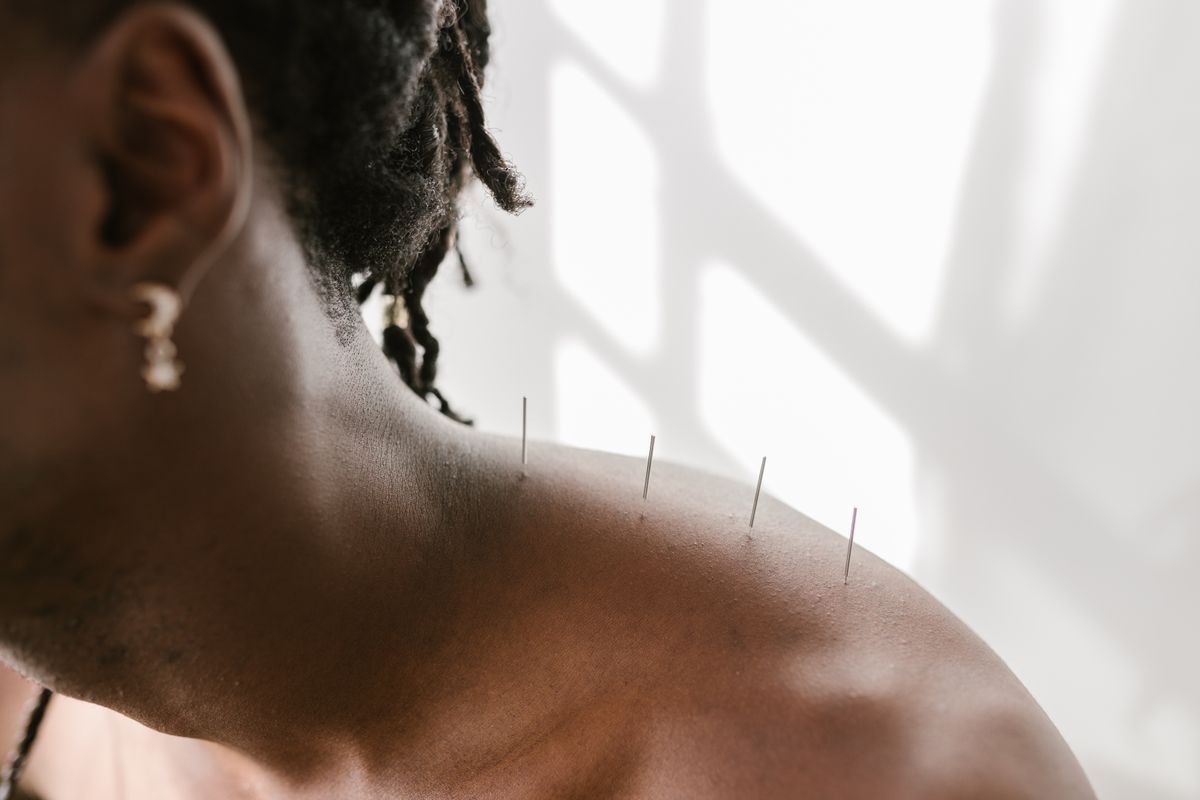
Dry needling is the insertion of a fine sterile needle — with no injected substance, hence "dry" — directly into a myofascial trigger point in a muscle. The difference from acupuncture is not the needle; it is the map behind it. Dry needling is a Western technique grounded in muscle anatomy: the clinician palpates the taut band, locates the tender nodule, and inserts the needle to provoke a local twitch response that releases it. Acupuncture follows the meridian and point map of Traditional Chinese Medicine, and the needling site is not necessarily where the pain is.
IMS (Intramuscular Stimulation) is a variant of dry needling developed in Canada, focused on muscle shortening driven by segmental nerve hypersensitivity. In most jurisdictions dry needling is performed by physiotherapists with dedicated training, while acupuncture is performed by licensed acupuncture practitioners. For the acupuncture pairing specifically, see our PEMF & Acupuncture integration protocol.
PEMF (Pulsed Electromagnetic Fields) is the opposite side of the same coin: not a point, but a volume. A coil generates a pulsed magnetic field that passes through clothing, skin, fat and bone without significant absorption in superficial tissue, influencing the electrical charge across cell membranes throughout the field.
Why Integrative Medicine — and What the Evidence Actually Says
Integrative medicine connects advanced medical technology, targeted treatments and rehabilitation inside a single treatment plan. This is not a marketing slogan; it has been tested — and the result is positive but moderate, which is how it should be presented. A Cochrane systematic review published in the BMJ examined multidisciplinary biopsychosocial rehabilitation for chronic low back pain: 41 randomised controlled trials, 6,858 participants, most with pain lasting over a year and many having already failed previous treatment. Multidisciplinary rehabilitation reduced pain and disability versus usual care with moderate-quality evidence — standardised mean difference 0.21 for pain (95% CI: 0.04–0.37) and 0.23 for disability (95% CI: 0.06–0.40) (PubMed 25694111).
- Better outcomes per session — each method acts on a different mechanism, so the combined visit covers more than either does alone.
- Cumulative success over a course — the whole series becomes broader, instead of repeating one modality ten times.
- A 360° treatment envelope — several methods matched to the patient in one place, without sending them between clinics.
⚠ The caveat that has to be said: a combination being mechanistically sensible does not prove it beats each component alone. That has to be tested pair by pair — and below is exactly what has and has not been tested.
What the Research Says About Dry Needling
The evidence base is reasonable and expanding, though not uniform. The most recent meta-analysis, published in 2026, included 20 randomised controlled trials and 1,234 patients with knee disorders — osteoarthritis and patellofemoral pain syndrome. Dry needling at trigger points significantly reduced pain across every pain measure: NPRS weighted mean difference −1.00 (95% CI: −1.25 to −0.76) with zero heterogeneity (I²=0%), VAS −1.19, and WOMAC pain subscale −1.76 (PubMed 41961845). The zero heterogeneity on NPRS is a particularly strong signal: the trials agreed with each other.
And here is the finding that bears directly on the idea of combining. A 2024 systematic review asked a sharper question — is deep dry needling plus stretching better than stretching alone for trigger points? Five RCTs were included, and the pooled effect size for pain was −1.73 (95% CI: −3.06 to −0.40) favouring the combination (PubMed 39593416). ⚠ Read it carefully: four of the five trials were rated unclear risk of bias and one high, and the confidence interval is very wide. This is a signal of direction, not proof. The principle it does demonstrate matters here: adding a second modality to a first can yield more than either alone.
For comparison, acupuncture has a far larger evidence base in chronic pain: an individual patient data meta-analysis covering 39 RCTs and 20,827 patients found acupuncture superior to both sham and no-acupuncture control across musculoskeletal pain, osteoarthritis, chronic headache and shoulder pain, by roughly 0.5 SD versus no treatment and 0.2 SD versus sham — with the effect persisting at one year with only about 15% decay (PubMed 29198932).
What the Research Says About Combining PEMF With Other Treatments
On the positive side: a double-blind, placebo-controlled trial evaluated adding PEMF to an exercise programme in older adults with knee osteoarthritis — 60 participants, 83 knees, randomised to active PEMF plus exercise, microwave plus exercise, or sham PEMF plus exercise. At four-month follow-up the PEMF plus exercise group showed superior pain relief compared with sham plus exercise (WOMAC pain, between-group mean difference −3.2 ± 1.2, p=0.028) and compared with microwave (VAS, −2.1 ± 0.9, p=0.042) (PubMed 39868691). This is exactly the structure that matters: identical exercise in both arms, with the magnetic field the only difference.
A second trial, multi-centre and published in 2026, tested four arms in 120 adults with Kellgren-Lawrence grade 2+ knee osteoarthritis: an external Chinese herbal cream with PEMF and exercise, cream with exercise, PEMF with exercise, and exercise with health education. The full combination group produced the best result — a 3.0-point VAS reduction (p<0.001), sustained at follow-up (VAS 2.8 versus 5.8 at baseline; WOMAC 14.2 versus 24.8) (PubMed 41185423). It is the closest existing study to our question — PEMF combined with a traditional therapy — though the other modality there is a cream, not a needle.
What Has Not Been Tested — Being Honest About the Gaps
Three gaps, all stated explicitly, because a clinic that knows the limits of the evidence makes better decisions.
- No randomised controlled trial has ever tested dry needling combined with PEMF. A PubMed search run while writing this article, crossing pulsed electromagnetic fields with dry needling or acupuncture under a randomised-controlled-trial filter, returned zero results. Everything written here about the combination itself is mechanistic reasoning and clinical sequencing — not direct evidence.
- Adding PEMF has not always added benefit. A single-blind RCT compared PEMF plus progressive resistance exercise against progressive resistance exercise alone in knee osteoarthritis: 34 patients, 24 sessions, follow-up to six months. There was no significant group-by-time interaction for any outcome — both groups improved similarly (PubMed 37718773). The sample is small, but the finding runs opposite to the trial cited above, and both are presented here side by side.
- In head-to-head comparison, PEMF does not always lead. A 2025 RCT compared extracorporeal shockwave therapy, low-level laser therapy and PEMF in 120 patients with grade 2–3 knee osteoarthritis, all performing a daily exercise programme. Every group improved significantly, but the improvement in the PEMF group was significantly lower than in the shockwave and laser groups (PubMed 39860600). ⚠ This is an inconvenient result for us and it is reported in full: in that indication, on those short-term measures, the two other modalities delivered more.
The practical conclusion from all three is not "do not combine" but "combine and measure": set one outcome measure before the course begins, measure it every three sessions, and drop the modality that is not moving it. An integrative approach is not a licence to keep adding methods without checking whether they work.
How to Combine Them in an Actual Clinic Visit
The physiological mechanism in muscle tissue
A myofascial trigger point is a localised region of contracted sarcomeres within a taut band, where local blood flow is poor, the tissue is relatively hypoxic, and inflammatory and pain mediators accumulate. The needle disrupts the local contraction mechanically. The pulsed magnetic field works on an entirely different mechanism: it influences the potential difference across the cell membrane and calcium ion movement, affecting cellular energy production and inflammatory mediator regulation throughout the tissue volume inside the field — not only at the point. Hence the logical sequence: the needle treats the point, the field treats the area around it.
Recommended order of operations
- Diagnosis and screening first. Confirm the pain is myofascial and not referred from a structural or systemic source. No diagnosis, no treatment.
- Dry needling to the trigger points — by a clinician licensed and trained for it, within their scope of practice.
- Immediately afterwards, a PEMF session of about 30 minutes over the same region, with the patient lying or sitting comfortably and fully clothed. This is the window in which the tissue is sensitised from the needling, and the magnetic field adds no further mechanical stimulus to it.
- Active exercise in the same visit, immediately after the session — within the newly available range. This is the critical step: passive modalities open a window of reduced pain, and the exercise is what converts that window into lasting change.
- Measure every three sessions on the same outcome measure, and decide explicitly whether to continue, change or stop.
Frequency: in clinic, once to twice weekly. Course length is at the clinician's discretion and not fewer than three sessions, which is the minimum needed to judge a response at all.
⚠ A clear note on scope of practice: dry needling is an invasive procedure permitted only to clinicians trained and licensed for it. PEMF is non-invasive and involves no tissue penetration. Combining the two in one visit does not make either permissible to someone not authorised to perform it.
How Do the Four Modalities Compare?
| Parameter | PEMF | Dry needling / IMS | Acupuncture | Shockwave |
|---|---|---|---|---|
| Principle | Pulsed magnetic field through the tissue volume | Mechanical release of a muscle trigger point | TCM point and meridian map | Focused acoustic pressure waves |
| Invasiveness | Non-invasive, works through clothing | Invasive — needle into muscle | Invasive — needle insertion | Non-invasive |
| Sensation | Nothing at all | Brief muscle twitch; 1–2 days of soreness | Mild pressure or tingling | Often uncomfortable to painful |
| Area of effect | Volumetric — the whole field | Highly focal | Focal, sometimes distant from the pain | Small to moderate focus |
| Who performs it | Any trained staff member; no hands-on contact | Trained physiotherapist or physician | Licensed acupuncture practitioner | Physiotherapist or physician |
| Evidence depth | 2025 multi-centre RCT N=91, plus per-indication trials | 20 RCTs, N=1,234 (knee) | 39 RCTs, N=20,827 (chronic pain) | Large; outperformed PEMF in a direct knee comparison |
| Clinician time | Hands-free — the device runs alone | Active presence throughout | Insertion, then patient rests with needles | Active presence throughout |
Clinic System or Home Device?
There are three distinct equipment categories, and confusing them is the most common error: a clinical PEMF system operated in clinic after diagnosis, with the highest field intensity, a full coil range and a per-indication protocol library; a medical-grade home device, which PainFree rents and sells to patients for home rehabilitation, with preset programmes and simple operation, usable while reading or watching television; and consumer wellness products such as magnetic mats, which are not medical equipment and have no defined indication.
| Parameter | Clinical PEMF system | Medical-grade home device |
|---|---|---|
| Field intensity | The highest of the categories | Stronger than common consumer home devices, weaker than the clinical system |
| Possible treatment frequency | Once to twice weekly | Daily, even twice daily |
| Combination with dry needling | Yes — same visit, in sequence | No — needling is clinic-only; the home unit is used between visits |
| Access | In clinic, after diagnosis | Monthly rental or purchase |
Intensity and frequency are two different axes, and that is the point: the clinical system is stronger, but patients reach it once or twice a week. The home device is weaker, but allows daily treatment — and for symptoms that follow a daily cycle, cumulative dose is the real difference between the two routes. The monthly home rental route lets a patient test the treatment at home before deciding to buy. ⚠ A home device is not a substitute for diagnosis, and must never be used to delay medical assessment of pain that is worsening, radiating or accompanied by warning signs.
The Business Case for a Clinic
Why this is not "just another passive modality"
Experienced physiotherapists are sceptical of passive modalities on principle, and the scepticism is justified: a modality that replaces exercise is harmful. That is precisely not the role of PEMF here. Its job is to open a window of reduced pain in which the patient can actually perform the exercises they were given — particularly after a dry needling session, when the muscle is sore. A patient in too much pain to exercise does not do the home programme, and that non-adherence is the single most common reason a course of treatment fails.
Hands-free operation and clinic economics
A PEMF session does not require the clinician's hands: the device runs alone for around 30 minutes. Operationally, that means the revenue from the session is generated while the clinician delivers manual therapy or needling to another patient in a parallel room. It does not compete with the manual therapy fee — it is additional to it, and therefore raises the value of the clinic hour. This is the substantive difference from shockwave and from needling, both of which require the clinician's active presence throughout.
⚠ The calculation only holds in a clinic with a spare room and sufficient patient volume — in a single-room clinic this operational advantage does not exist.
Equipment routes
- Operational leasing — fixed monthly payment, tax-deductible, no upfront capital.
- Outright purchase — priced by configuration and coil count.
- Included in both — clinical staff training, a per-indication protocol book, and ongoing technical and clinical support for the life of the system.
Frequently Asked Questions
Does dry needling hurt?
Yes, to a degree — it is a treatment you feel. Needle insertion is usually accompanied by a brief muscle twitch, followed by one to two days of local soreness similar to post-exercise ache. This is entirely different from PEMF, which is not felt at all and involves no needle.
What is the difference between dry needling and acupuncture?
The difference is the targeting method, not the needle. Dry needling locates the point by muscle anatomy and inserts into the trigger point itself. Acupuncture selects the point from the TCM meridian map, which may be far from the painful area. The training and the profession also differ.
Does PEMF replace dry needling?
No. In the clinic, PEMF takes the place of other passive pain-reduction modalities, and manual therapy and active exercise continue together with it. Dry needling acts on a local mechanical mechanism the magnetic field does not reproduce, so the two work together rather than compete.
Can both be done in the same visit?
Yes, and that is the usual sequence in clinics that combine them: needling first, then a PEMF session over the same region, then active exercise in the same visit. ⚠ No randomised trial has tested this sequence, so it is clinical reasoning rather than evidence. There is no known safety barrier to combining them, provided neither has a contraindication.
How many sessions before improvement?
Usually several. Course length is at the clinician's discretion and not fewer than three sessions, the minimum required to judge a response. If there is no change in the pre-agreed outcome measure after several sessions, that is a signal to change the plan or re-refer — not to continue unchanged.
Is PEMF safe?
Yes, for most people. It is non-invasive, does not heat tissue and involves no ionising radiation, and is suitable for adults, athletes and children. Clear contraindications apply: cardiac pacemaker or any active electronic implant, pregnancy, active epilepsy, acute infection at the treatment site, and unmanaged bleeding disorder. ⚠ Dry needling carries its own separate contraindications — including anticoagulant therapy, bleeding disorders, local infection and significant needle phobia — which are the treating clinician's decision.
Key Takeaways
- Dry needling works on a point; PEMF works on a volume — which is why they work together rather than compete.
- Dry needling has a reasonable evidence base — 20 RCTs, N=1,234, a 1.00-point NPRS reduction in knee disorders.
- The specific dry needling + PEMF combination has never been tested in an RCT. That is a clinical judgement, and we say so explicitly.
- The evidence on adding PEMF is not one-directional — one trial found a significant advantage at four months, another found no difference, and in a direct knee comparison shockwave and laser delivered more.
- Active exercise immediately after the session is what turns pain relief into lasting change. A passive modality without exercise is a missed opportunity.
References
- Vickers AJ, Vertosick EA, Lewith G, et al. Acupuncture for Chronic Pain: Update of an Individual Patient Data Meta-Analysis. The Journal of Pain 2018;19(5):455-474 — PubMed 29198932
- Kamper SJ, Apeldoorn AT, Chiarotto A, et al. Multidisciplinary biopsychosocial rehabilitation for chronic low back pain: Cochrane systematic review and meta-analysis. BMJ 2015;350:h444 — PubMed 25694111
- The effectiveness of dry needling at myofascial trigger points for knee disorders: A quantitative synthesis of randomized controlled trials. PLoS One 2026 — PubMed 41961845
- Effectiveness of deep dry needling combined with stretching for the treatment of pain in patients with myofascial trigger points: A systematic review and meta-analysis. Journal of Bodywork and Movement Therapies 2024 — PubMed 39593416
- Effect of Pulsed Electromagnetic Field and Microwave Therapy on Pain and Physical Function in Older Adults With Knee Osteoarthritis: A Randomized Clinical Trial. Journal of Geriatric Physical Therapy 2026 — PubMed 39868691
- Effects of Sanqi Shengyu External Application Cream and Pulsed Electromagnetic Field on Knee Osteoarthritis in Older Adults: A Randomized Controlled Trial. Physiotherapy Research International 2026 — PubMed 41185423
- Effects of the combination of pulsed electromagnetic field with progressive resistance exercise on knee osteoarthritis: A randomized controlled trial. Journal of Back and Musculoskeletal Rehabilitation 2024 — PubMed 37718773 (found no advantage for the combination)
- Comparison of Short-Term Effects of Extracorporeal Shock Wave Therapy, Low-Level Laser Therapy and Pulsed Electromagnetic Field Therapy in Knee Osteoarthritis: A Randomized Controlled Study. Journal of Clinical Medicine 2025 — PubMed 39860600 (PEMF underperformed shockwave and laser)
- Evaluating Noninvasive Pulsed Electromagnetic Field Therapy for Joint and Soft Tissue Pain Management: A Prospective, Multi-center, Randomized Clinical Trial. 2025 — PMC11914662
This article is informational and is not medical advice. It does not replace diagnosis, treatment or follow-up by a treating physician. Regulatory clearance always applies to a specific device model and has an expiry date — ask to see the current certificate for the model offered to you.