July 2026 · 10 min read · Clinical Protocol
📄 This page focuses on the insertional form only — pain at the tendon's attachment to the heel bone. The complete PainFree reference on Achilles tendinopathy — symptoms, differential diagnosis, what the research actually shows, the clinical protocol and FAQs — is here: the main Achilles tendinopathy guide.
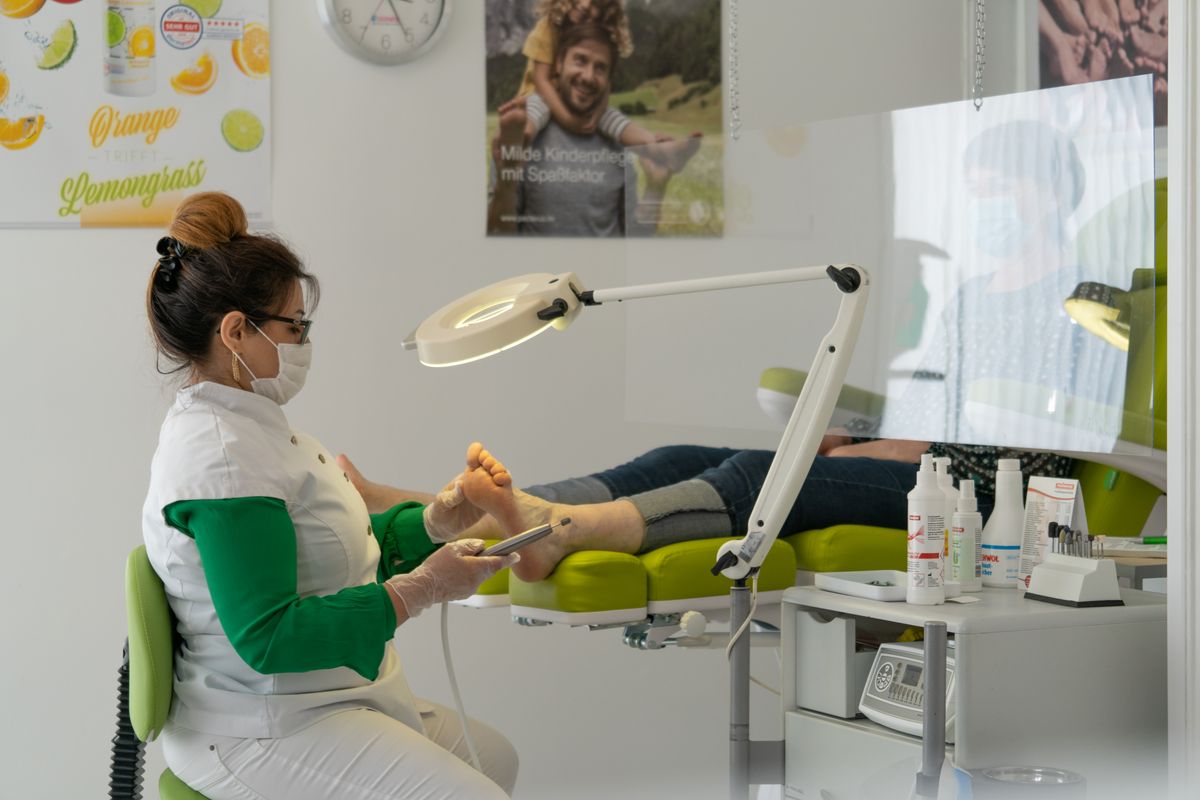
Insertional Achilles tendinopathy accounts for roughly a fifth to a third of all Achilles tendon presentations, and it is the variant most likely to frustrate both patient and clinician. The pain sits at the back of the heel, exactly where the tendon anchors into the calcaneus — an area with a naturally poor blood supply, where healing is slow and where the tendon is mechanically compressed against bone every time the ankle dorsiflexes.
The clinical consequence is significant: the eccentric heel-drop protocol that works well for mid-portion tendinopathy can aggravate the insertion, because it drives the tendon into the very compression that is irritating it. Getting the diagnosis right therefore changes the entire treatment plan. PainFree is the long-established importer and integrator of advanced Italian PEMF systems, with 25+ years of experience and 70+ Israeli clinics (population: 9M) — now expanding to the Philippines.
Why the Insertion Is a Different Problem
Not all Achilles tendinopathy is the same, and the distinction drives both loading and coil placement:
- Mid-portion tendinopathy — affects the tendon body roughly 2–6 cm above the heel bone. It is the more common presentation and generally responds well to eccentric loading.
- Insertional tendinopathy — occurs at the calcaneal attachment itself. It is compression-sensitive, so loading must be modified (typically avoiding deep dorsiflexion), and progress is slower.
Two structures frequently travel with it and should be assessed: Haglund's deformity (a bony prominence on the back of the calcaneus that increases the compressive conflict) and retrocalcaneal bursitis (inflammation of the bursa sitting between tendon and bone). Intratendinous calcification at the insertion is also common in longstanding cases.
The Headline Evidence
The strongest clinical evidence for PEMF in joint and soft-tissue pain comes from a 2025 prospective, multi-center randomized trial with crossover, run across five orthopedic clinics (PMC11914662). Of 120 enrolled, 91 completed: 48 on PEMF, 43 on standard care.
- 36% pain reduction in the PEMF group vs. 10% with standard care (p<0.0001)
- 55% reduction in medication consumption, vs. 12% with standard care
An important clarification: this trial studied joint and soft-tissue pain in general — it was not conducted on insertional Achilles tendinopathy specifically. It supports the general tissue-level effect of PEMF, and should be read that way rather than as condition-specific proof.
How PEMF Works on the Tendon
PEMF delivers low-intensity electromagnetic pulses into the tissue, acting at the cellular level without heat and without direct skin contact. The mechanisms relevant to a compressed, poorly-perfused tendon insertion are:
- Improved microcirculation — local vasodilation and better oxygen delivery to an insertion zone where perfusion is inherently low.
- Reduced inflammation — lower inflammatory cytokine activity and less local oedema, helping break the chronic pain–inflammation loop.
- Cellular activity (ATP) — support for the tenocyte activity and collagen production needed to rebuild tendon fibres.
- Tissue repair support — angiogenesis and more organised collagen remodelling, documented in a clinical review by Strauch et al. (Aesthetic Surgery Journal, 2009, Albert Einstein College of Medicine — PubMed 19371845).
- Pain-signal modulation — reduced local pain signalling, which improves tolerance to the loading programme.
PEMF therapy has been studied for chronic pain, inflammation reduction and improved local blood flow — the three processes that matter most in tendon healing.
An Honest Look at the Evidence
Direct evidence for PEMF in insertional Achilles tendinopathy specifically is limited. There is no dedicated randomized controlled trial for this presentation. The rationale rests on general joint and soft-tissue pain research plus the established mechanisms above — and because the insertion is characterised by oedema, local inflammation and impaired microcirculation, PEMF's documented effects on exactly those processes make it a direct and reasonable clinical rationale.
It is also worth stating plainly where the literature is not uniform: some recent randomized trials found no significant advantage for PEMF when it was added to a rehabilitation programme already built on eccentric loading. That is why PEMF at PainFree always runs together with the adapted graded-loading programme, the standard evidence-based tendon rehabilitation. FDA-cleared PEMF devices are in use worldwide as part of rehabilitation and pain-management programmes.
The 3-Phase Clinical Protocol
In the absence of an insertional-specific trial protocol, this framework rests on general PEMF parameters for connective and soft tissue, on the Strauch review regarding pain/oedema control and soft-tissue healing, and on 25+ years of accumulated clinical experience in the clinics using the technology.
- Acute phase — settle pain and oedema while reducing provocative load. Critically, this means avoiding deep dorsiflexion under load — the position that compresses the tendon against the calcaneus. PEMF supports pain-signal modulation and circulation during this settling period.
- Sub-acute phase — introduce graded loading within a pain-free range. For the insertion, this often begins with isometrics and mid-range work rather than full heel-drops off a step, progressing only as tolerance allows.
- Functional phase — controlled return to activity, calf strengthening, and footwear/biomechanics review to address what caused the overload.
Practical tips: avoid shoes with a rigid heel counter that presses on the insertion, and consider a temporary heel lift to offload the compressive conflict.
Treatment frequency: 1–2 times per week, up to 3 times weekly in severe cases at the outset with a rest day between sessions. Session length is 30 minutes. A series of 3 or more treatments is typical, at the discretion of the treating physician or physiotherapist. Some patients report improvement after only a few sessions, while full measurable improvement typically develops over several weeks.
PEMF vs. Other Treatment Options
| Parameter | PEMF | Shockwave (ESWT) | Corticosteroid injection | Physiotherapy & graded loading |
|---|---|---|---|---|
| Mechanism | Cellular: circulation, anti-inflammatory, tissue repair | Mechanical stimulus; breaks down calcification | Local anti-inflammatory, short-term | Rebuilds tendon load capacity |
| Invasiveness | Non-invasive, no needle | Non-invasive (external applicator) | Invasive — injection into tissue | Non-invasive |
| Patient experience during treatment | Pleasant and painless | May cause temporary local pain | Requires a medical injection | Controlled discomfort during exercise |
| Clinic supervision needed | No continuous supervision required | Requires a trained operator throughout | Requires a physician | Requires hands-on therapist time |
| Suitability at the insertion | Suitable; no mechanical loading of the tendon | Used for chronic insertional cases | Widely considered problematic — tendon-weakening and rupture risk | Essential, but loading must be modified |
| Repeatability | Repeat series with no known limit | Repeatable per clinical judgement | Limited — cumulative tissue risk | Ongoing throughout rehabilitation |
| FDA status | Not for the devices we supply — no FDA 510(k) or PMA. Other PEMF devices hold 510(k) for pain/edema; clearance is granted per model, not to the technology. Our Magnetobox unit carries CE. | FDA cleared for certain indications | Approved medication, physician-administered | Not a device; no clearance required |
Every technology has its place depending on the clinical situation and the treatment goal. In many cases combining PEMF with shockwave or graded loading may amplify results — the choice is not necessarily either/or.
What This Means for Philippine Clinics
Insertional Achilles pain is a high-volume, long-retention presentation: chronic patients, extended treatment cycles and a high recurrence rate. For a clinic, three things matter operationally.
- It runs hands-free. The system delivers the protocol without a therapist in the room, so the clinic can treat another patient in parallel and increase revenue passively — without burning out staff.
- It is a non-invasive alternative in a presentation where corticosteroid injection carries real tendon-rupture risk — clinically valuable, and a genuine differentiator.
- Typical session pricing in the Philippine market runs ₱1,500–₱2,500 per session, with a series of 3 or more sessions per treating clinician's judgement.
Support includes full clinical training, structured protocols and ongoing professional backing.
Contraindications
- Pacemaker or implanted defibrillator
- Pregnancy
- Active epilepsy — neurological consultation required
- Active malignancy (there is no scientific proof for this contraindication; it is accepted for insurance reasons only)
- Hyperthyroidism
- Metal implants near the treatment site — depending on location and medical judgement
- Suspected complete tendon rupture — requires medical assessment before any conservative treatment
Frequently Asked Questions
How do I know if it is insertional or mid-portion?
Location is the primary clue. Insertional pain sits at the back of the heel where the tendon meets the bone; mid-portion pain sits 2–6 cm higher up the tendon body. The distinction matters because compression-sensitive insertional cases need modified loading, so it should be confirmed clinically before a programme is designed.
Is PEMF treatment painful?
No. Treatment is entirely comfortable — no needles, no injections, no surgery. The patient sits or lies down for the session, and some report a mild sensation of warmth or relaxation. There is no recovery period and normal activity can resume immediately afterwards.
Why can't I just do heel drops?
Because heel drops take the ankle into deep dorsiflexion, which compresses the tendon against the heel bone — the exact mechanism irritating an insertional tendinopathy. Loading is still essential, but it usually starts with isometric and mid-range work and progresses as tolerance allows.
How long until I see improvement?
Some patients report improvement after only a few sessions. Full measurable improvement usually develops over several weeks, with loading and load management continuing together with the sessions. The insertion is a naturally slow-healing area, so patience is required.
Does PEMF replace physiotherapy?
You do not have to choose. PEMF leads the clinic treatment — it works on the pain and the tissue at the heel — and the physiotherapy and exercises you already do continue together with it. Most of the research tested PEMF together with an exercise programme, particularly in musculoskeletal and soft-tissue pain.
Can PEMF be combined with shockwave?
Yes, and it is a common pairing. Shockwave provides mechanical stimulus to the tissue, while PEMF acts as a calming, anti-oedema layer before or after. Combining shockwave with pulsed electromagnetic field therapy will give better results — multidisciplinary medicine at its best.
Can both heels be treated in the same session?
Yes, depending on the system and the clinician's judgement. Bilateral insertional involvement is not unusual, particularly in non-athletic patients. Coil placement is set according to the areas being treated.
When should a patient see a doctor urgently?
Immediately if there is a suspected rupture — an audible snap, sudden weakness, or inability to push off or stand on tiptoe. Also for significant swelling, inability to bear weight, signs of infection, or pain that fails to improve despite several weeks of structured conservative care.
Interested in adding PEMF to your clinic?
Request the full investment brief — machine specs, financials, and site selection for the Philippines market.
Request Investment Brief →PainFree operates 70+ Israeli clinics serving a population of 9M — now expanding to the Philippines.